Last Updated on 5th July 2026 by admin
Monet (Oscar Claude Monet) was a famous French painter who played an important role in the movement of Impressionism. He is renowned for his landscape paintings that capture the changing effects of light and color in nature. Rather than concentrating on detail, he tried to paint nature as it appeared.
He was born on November 14, 1840, in Paris. His father, Claude-Adolphe Monet, was a practical businessman who sold groceries for ships. However, his mother was very different; she loved music, poetry, and art, and it was she who supported her son’s talent. Claude Monet passed away on December 5, 1926, at the age of 86 but he left behind a collection of many iconic paintings.
In this article, we will look at a curated list of famous Monet paintings. All of his works show his unique style and help us understand why Monet is one of the greatest painters of all time.
1. “Impression, Sunrise”
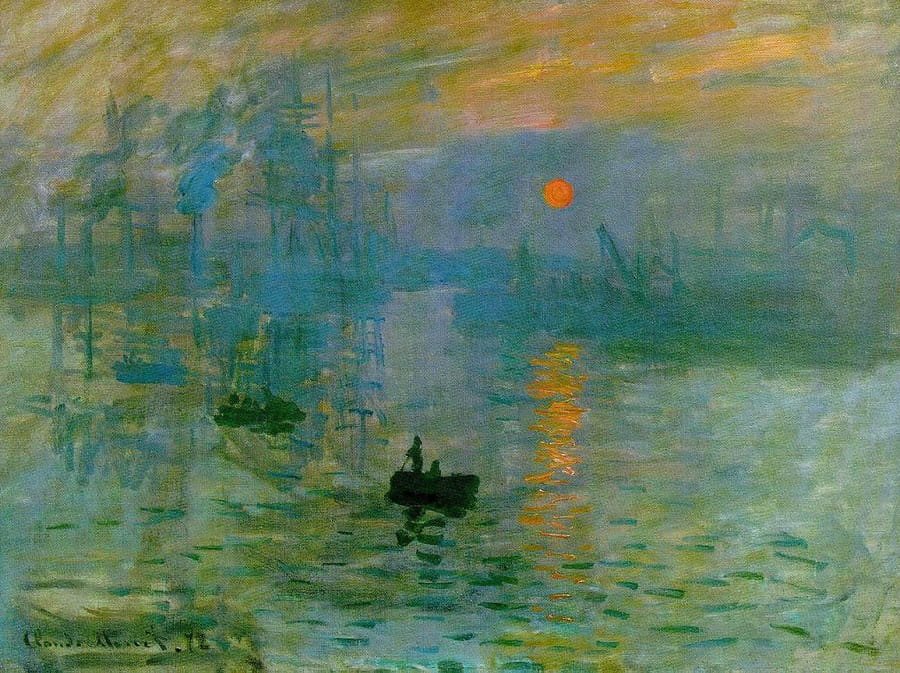
Impression, Sunrise (Impression, soleil levant) is one of the most influential paintings in modern art history, not just because of how it looks, but because it accidentally gave the Impressionist movement its name. Painted in 1872, it depicts the harbor of Le Havre, Monet’s hometown, at dawn.
In 1874, Monet and a group of young artists (including Renoir, Pissarro, and Degas) were fed up with being rejected by the traditional, conservative government art exhibitions in Paris. They decided to host their own independent show. When Monet exhibited this hazy view of the industrial harbor at Le Havre, an art critic mockingly seized on the word “Impression” in the title to label the entire group’s style as unfinished.
The painting broke away from traditional painting techniques by focusing more on light and atmosphere than fine detail. Rather than using smooth brushstrokes and crisp outlines, he painted rapidly outdoors (en plein air) using loose, visible dashes of paint. He allowed the distant ships, docks, and factory smokestacks to fade into the dense morning fog, capturing how the human eye experiences a fleeting, real-world moment.
2. “Water Lilies” Series”
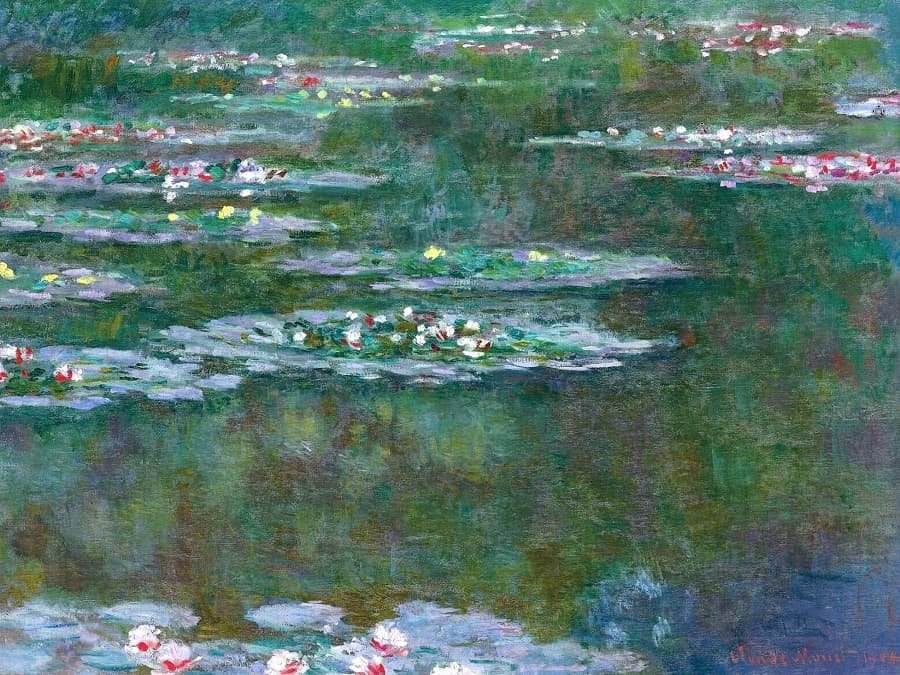
Claude Monet’s Water Lilies (Nymphéas) is a series of approximately 250 oil paintings focused on the pond in his home garden in Giverny, France. Created during the last thirty years of his life, the series became one of the most famous paintings in the world. The series is best known for documenting how a single physical subject changes under different times of day, weather conditions, and seasons.
One of the coolest features of this collection is that Monet completely threw out traditional rules of painting. He removed the horizon line, the sky, and the shoreline entirely. By forcing you to look only at the flat surface of the water, he tricks your eyes into seeing three different layers at the exact same time: the floating lilies, the dark depth of the water, and the colorful reflections of the trees and clouds above.
These paintings are also incredible because of the immense struggle behind them. Monet painted many of these giant, wide canvases while suffering from severe cataracts, which made his vision incredibly blurry and forced him to see colors mostly as heavy blues and dark reds. Despite his fading eyesight, he didn’t stop. His hard work eventually led to eight massive, curved panels permanently set up in the Musée de l’Orangerie in Paris.
3. “Rouen Cathedral” Series
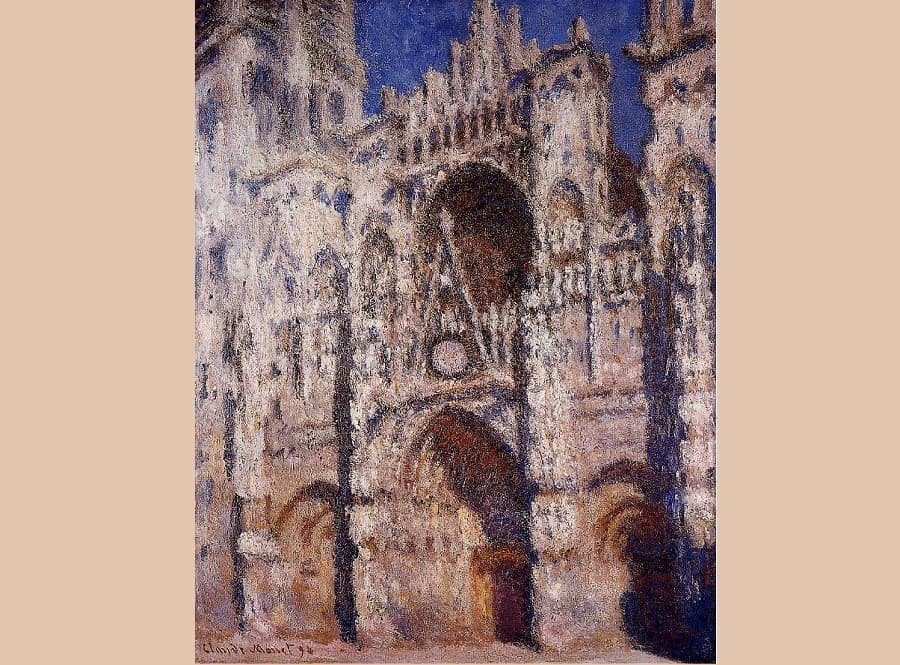
“Rouen Cathedral” (1892–1894) is a famous series of over 30 oil paintings where Claude Monet showed how a single stone building can completely change its appearance depending on the time of day, the weather, and the light. Instead of traveling around to find new landscapes, Monet set up his easel in one spot and let the shifting sunlight do all the work.
The paintings show how the cathedral loses its solid form. There are no sharp lines, bricks, or fine architectural details. The massive stone structure almost looks like it is made of colorful mist or melting fabric, completely wrapped in the atmosphere of the moment. Monet used a technique called impasto, applying layer after layer of thick, heavy paint to the canvas.
Because he painted at all hours, the series shows an incredible range of palettes. You can see the cathedral glowing with pale blues and deep shadows in the early morning, burning with bright yellows and oranges in the midday sun, or fading into soft, dull greys on an overcast day. Paintings are spread across major museums all over the world, including the Musée d’Orsay in Paris, the Metropolitan Museum of Art in New York, and the National Gallery of Art in Washington, D.C.
4. “Haystacks” Series
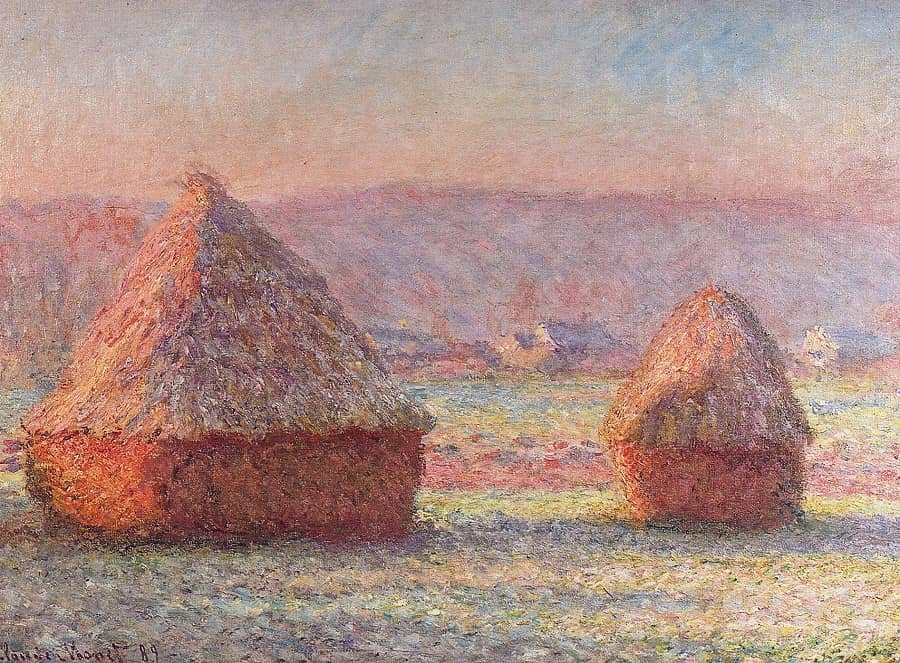
Monet’s “Haystacks” (actually stacks of wheat) is one of his most famous painting series in art history. In 1890 and 1891, he painted the exact same stacks in a field right outside his home in Giverny over 25 times. This was the first time an artist exhibited a massive series of paintings showing the exact same object.
He would carry multiple canvases out into the field at the same time. As the sun moved and the light shifted, he would switch to a new canvas to capture that exact moment. While everyone calls them “haystacks,” they were actually tightly packed stacks of wheat (or grain). Local farmers built them this way – up to 20 feet high – with thatched roofs to keep the grain dry until the threshing machines arrived in the winter.
To really understand the Haystacks series, it helps to see how the exact same field looked at completely different times of the year. Because these structures sat in the open fields for months, they gave Monet the perfect excuse to paint the exact same spot covered in bright summer sun, autumn fog, and freezing winter snow.
5. “Woman with a Parasol” (Madame Monet and Her Son)
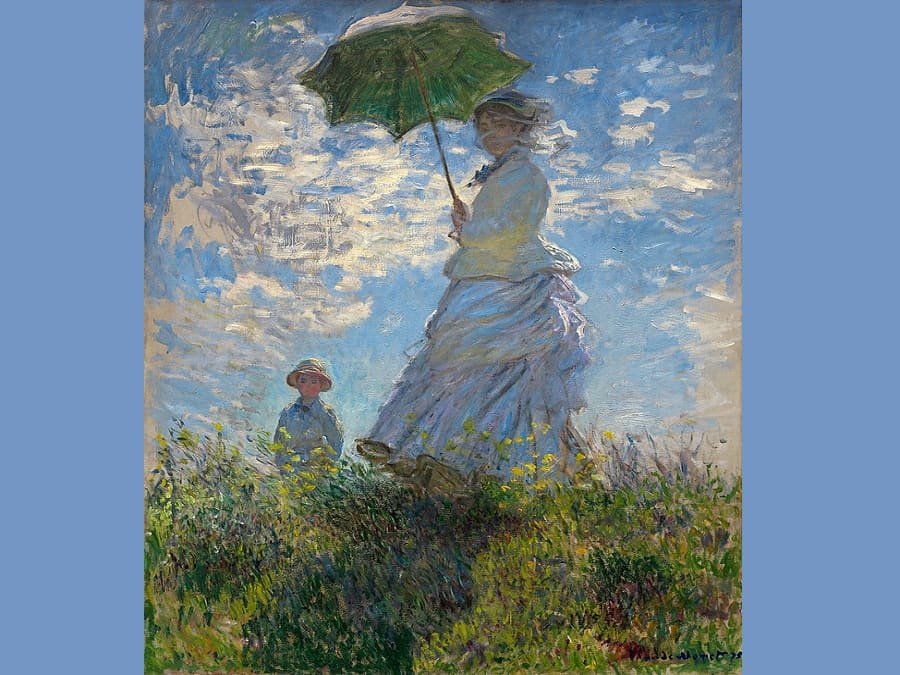
“Woman with a Parasol – Madame Monet and Her Son” (1875) is one of Claude Monet’s most celebrated masterpieces. It shows his first wife, Camille, and their young son, Jean, on a windy summer day in Argenteuil, France. Instead of a formal, stiff portrait, this painting feels like a casual snapshot taken while a family was out on a walk.
Monet stood lower down on the hill, looking up at his wife and son. This makes Camille look tall and elegant, framed entirely by the bright blue sky and sweeping white clouds. You can actually feel the breeze in this painting. Look at how Camille’s white dress swirls around her legs, the way the wild grass and flowers bend, and how her veil blows across her face.
The painting’s loose brushwork is especially noticeable in the sky and the grass, where thick dashes of paint create a sense of movement. Monet didn’t blend the colors smoothly; he used rapid strokes to capture the fleeting movement of the wind and light before it changed. Look closely at the grass, his quick paint strokes make you genuinely feel the wind. Today, it remains a favorite highlight at the National Gallery of Art and stands out as one of the most famous Monet paintings on display.
6. “The Japanese Bridge”
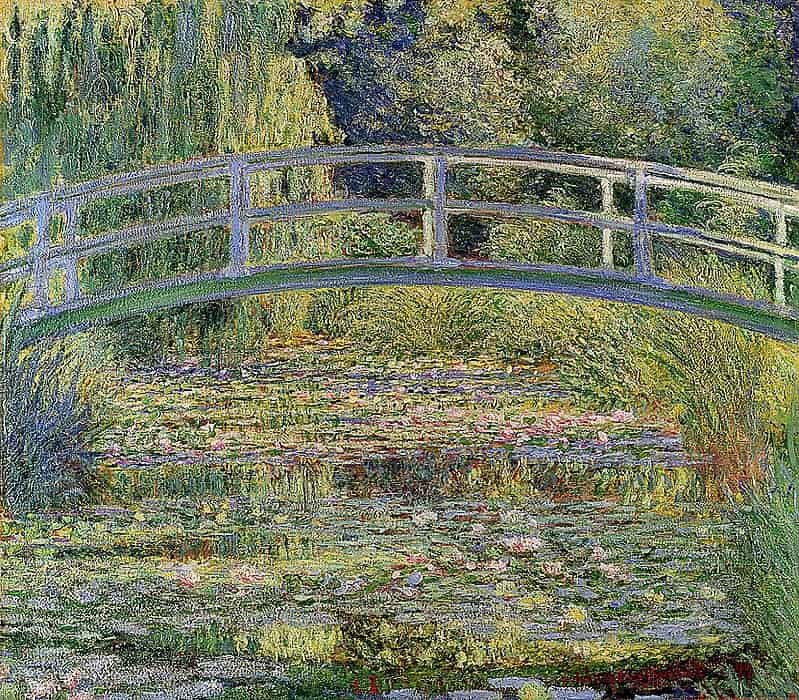
“The Japanese Bridge” refers to a beautiful wooden footbridge that Claude Monet built in his own water garden at Giverny. It became one of the most central themes of his later career, and he painted it roughly 45 times. He loved the bridge because it gave him a perfect structure to frame his favorite subjects: water lilies, weeping willows, and shifting reflections.
Monet was a huge collector of Japanese woodblock prints. When he designed his garden, he bought a piece of land across the railroad tracks from his house and built a classic, curved wooden bridge inspired by those prints. Traditional Japanese bridges are usually painted bright red. However, he chose to paint his a soft sea-green color so it would blend in naturally with the surrounding trees, water lilies, and reeds.
Comparing his early bridge paintings with those from the 1920s reveals how dramatically his style evolved. Monet loved this bridge so much that he painted it roughly 45 times, showing how his style grew much wilder, brighter, and more colorful as he aged.
7. “The Gare Saint-Lazare”
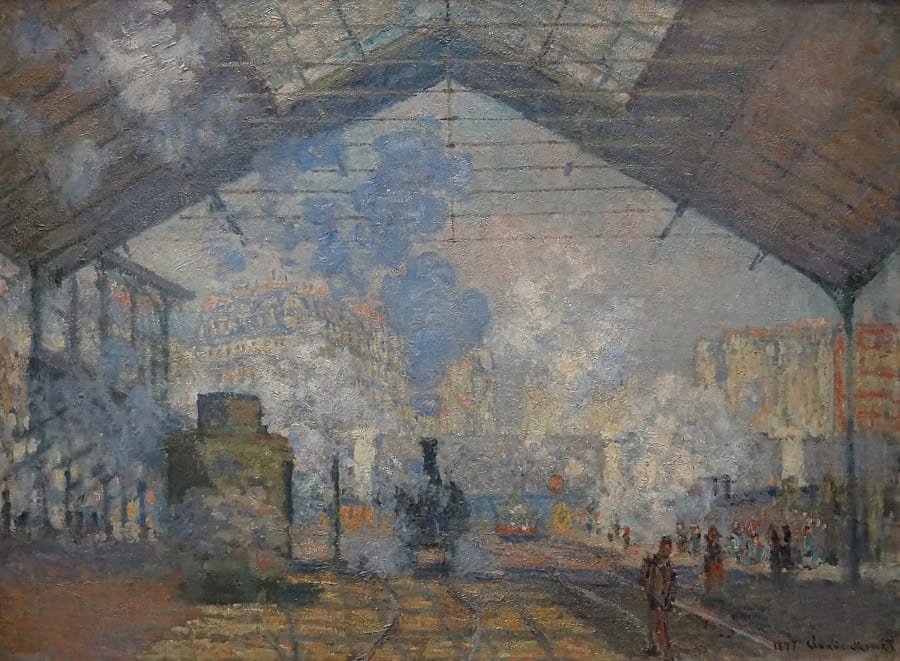
“The Gare Saint-Lazare” (1877) is a series of 12 paintings that Claude Monet made inside one of the busiest steam train stations in Paris. While he is mostly known for painting beautiful country gardens and rivers, this series shows how much he loved capturing modern, industrial city life. It is widely considered a massive triumph of the early Impressionist movement.
Instead of painting traditional historical scenes, Monet and his friends wanted to paint the real world around them. In the late 1800s, there was nothing more modern, fast-paced, and noisy than a steam train station. But he wasn’t just interested in the trains. What fascinated him most was the steam and smoke. He loved the challenge of painting how the thick, swirling clouds of train exhaust trapped the sunlight under the massive iron and glass roof.
The painting highlights the contrast between the station’s sharp iron framework and the soft, hazy clouds of blue and white steam. It is a massive triumph of early Impressionism, showing how Monet could take a noisy, dirty city train station and turn the swirling steam into pure beauty.
8. “Poppy Field”
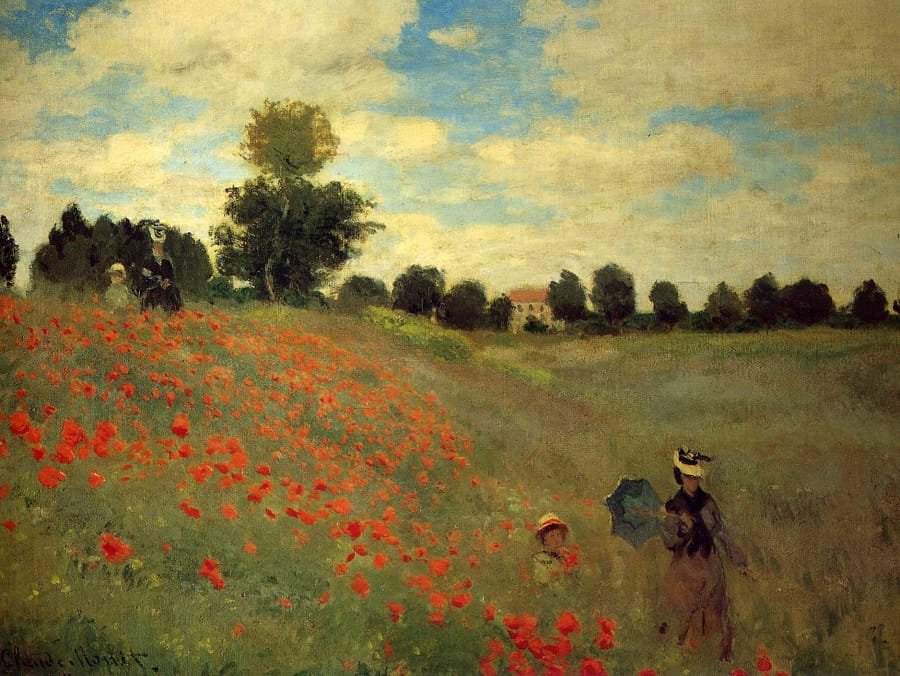
Hanging in Paris’s famous Musée d’Orsay, “Poppy Field” (1873) is one of Claude Monet’s absolute most famous and cheerful landscape paintings. It beautifully captures the feeling of a bright, breezy summer day as a mother and child stroll down a gentle hill covered in vibrant red wildflowers.
There are actually two pairs of people in the painting. At the top of the hill, you can see a woman and a child walking. Then, moving down the diagonal path closer to the viewer, you see them again. The figures are Monet’s first wife, Camille, and their young son, Jean. By painting them twice, he gives the scene a sense of movement, like a timelapse film showing them walking down the slope.
Monet skillfully structured the scene into distinct bands. The lower half is dominated by the warm, vivid red and green hill, while the upper half balances it out with a cool, vast sky filled with soft, drifting summer clouds. By painting his wife and son twice on the slope, he makes the whole scene feel like a quick, joyful family snapshot.
9. “The Cliff Walk at Pourville”
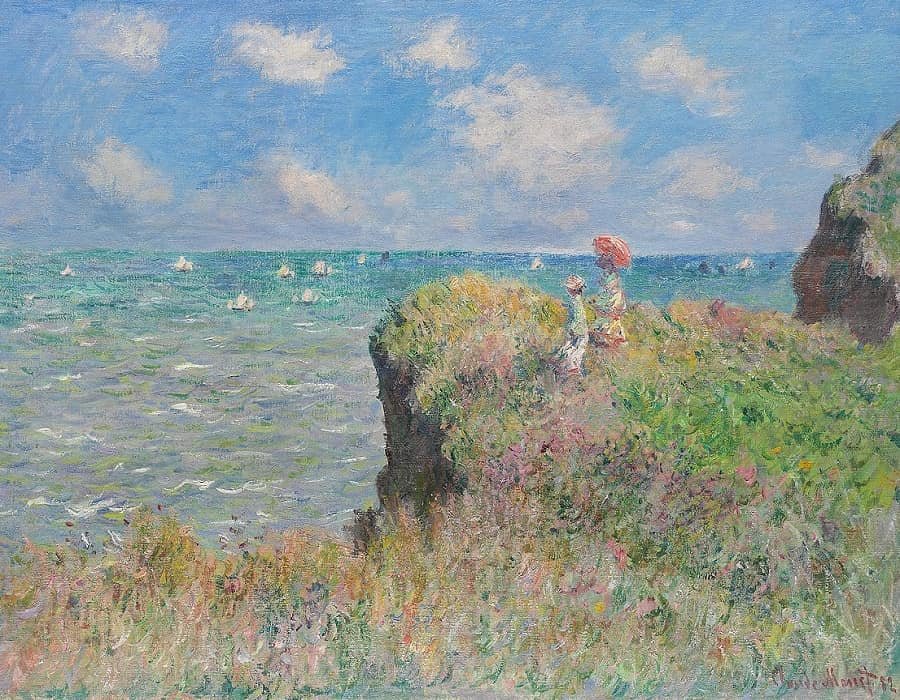
“The Cliff Walk at Pourville” (1882) is a beautifully bright landscape painted on the coast of Normandy, France. Monet had traveled to the small seaside resort village of Pourville to escape some of the stresses of his life and to paint the rugged cliffs, changing tides, and vast ocean waters. This peaceful artwork belongs to the Art Institute of Chicago, where it stands out as one of his most beloved coastal landscape works.
The two women standing on the cliff are believed to be Marthe and Blanche, the daughters of Alice Hoschedé (who would later become Monet’s second wife). Just like in Woman with a Parasol, they wear light summer dresses and carry a parasol, acting as a focal point that giving us a real sense of just how huge the cliffs are.
Now kept at the Art Institute of Chicago, this peaceful coastal landscape captures the rush of a breezy day perfectly. If you look closely at the quick, colorful paint strokes, you can practically feel the crisp sea air rippling through the tall grass while tiny white sailboats dance on the horizon.
10. “Charing Cross Bridge”
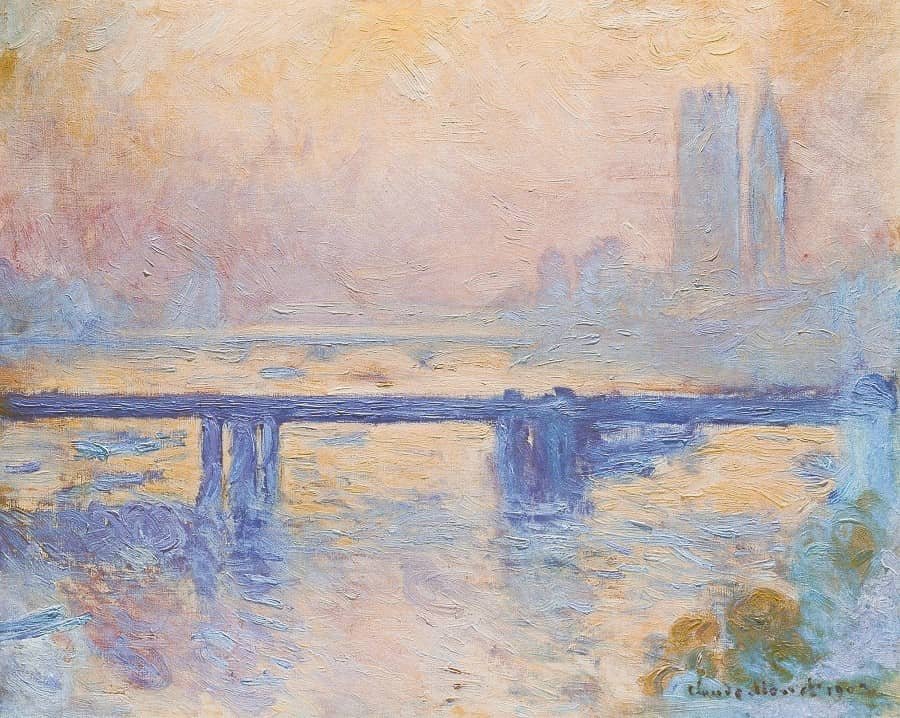
Between 1899 and 1904, Claude Monet traveled to London multiple times and created a spectacular series of paintings of the “Charing Cross Bridge” (along with Waterloo Bridge and the Houses of Parliament). Instead of sunny countrysides, these paintings capture the moody, mysterious atmosphere of the River Thames covered in London’s famous heavy fog.
In the “Charing Cross Bridge” series, Monet focuses on the stunning bridge in London, capturing its architectural details and the surrounding industrial elements. While most people complained about the thick, dirty industrial smog and fog in London, he absolutely adored it. He famously said: “Without the fog, London wouldn’t be a beautiful city. It’s the fog that gives it its magnificent breadth.”
Monet stayed at the luxury Savoy Hotel during his trips. He painted this series right from his room’s balcony on the fifth and sixth floors, which gave him a perfect elevated view looking down the River Thames toward the bridge. Instead of painting a crisp, clear landscape, Monet used the heavy fog like a magical prism to blur the sharp lines of the iron railway bridge, the steam trains passing over it, and the distant Victoria Tower.
11. “The Houses of Parliament” Series
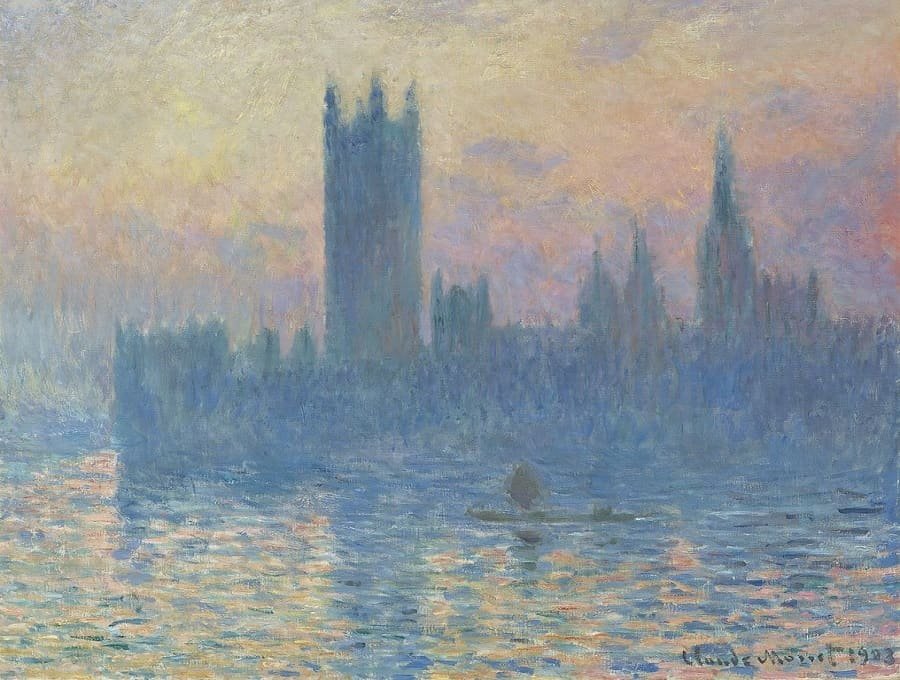
“The Houses of Parliament” is a spectacular series of 19 paintings that Claude Monet created during his trips to London between 1899 and 1904. Just like his Charing Cross Bridge series, he painted these from the exact same viewpoint: an upper-floor terrace at St. Thomas’ Hospital, looking across the moody, misty River Thames toward the iconic British government building.
“The Houses of Parliament” series by Claude Monet is a magnificent portrayal of the famous London attraction, offering viewers a visual symphony of the cityscape. In these paintings, the historic architecture of the Houses of Parliament loses its solid form. The towers and Gothic spires look like a dark, ghostly silhouette rising straight out of the water, completely enveloped by dense fog.
His favorite moments to paint were when the sun tried to pierce through the heavy London smog. The pale winter sun often looks like a bright, glowing orb of orange or pink, casting long, shimmering trails of light across the rippling surface of the Thames. He didn’t want a clean, postcard view of the buildings, he wanted to catch the exact second when the colorful city mist made the world look completely magical.
12. “The Artist’s Garden at Giverny”
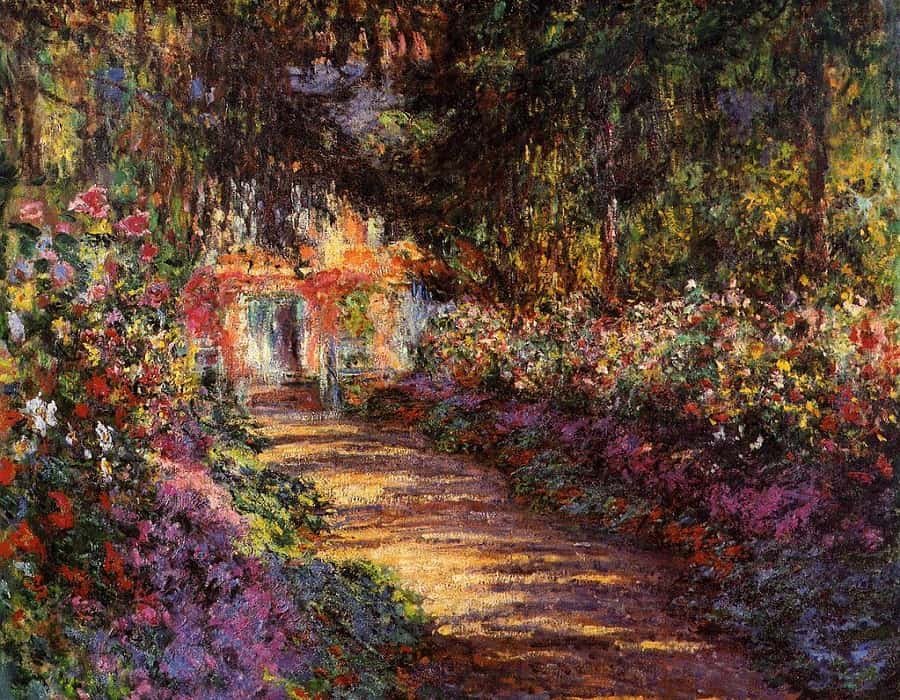
“The Artist’s Garden at Giverny” (1900) is one of Claude Monet’s most colorful and vibrant masterpieces. It shows a lush, sun-dappled pathway winding through rows of beautiful purple and pink irises right outside his home. While his Water Lilies focus purely on the water garden, this painting highlights the “Clos Normand” – the structured flower garden he designed in front of his house.
Irises were one of his favorite flowers. He planted them in massive quantities beneath rows of apple and apricot trees. In this painting, he blocks out the bottom and right corners with thick, layered brushstrokes of purple, violet, and pink to make you feel like you are standing right in the middle of the bushes.
Monet purposefully grouped flowers by color to see how they interacted. Here, the deep purples and pinks of the irises contrast vividly with the bright green foliage, making the colors look incredibly sharp and intense. Monet purposefully grouped these flowers by shade to see how they interacted, creating a bright sea of purple and green that stands out as a jewel of the Musée d’Orsay collection.
13. “The Seine at Argenteuil”
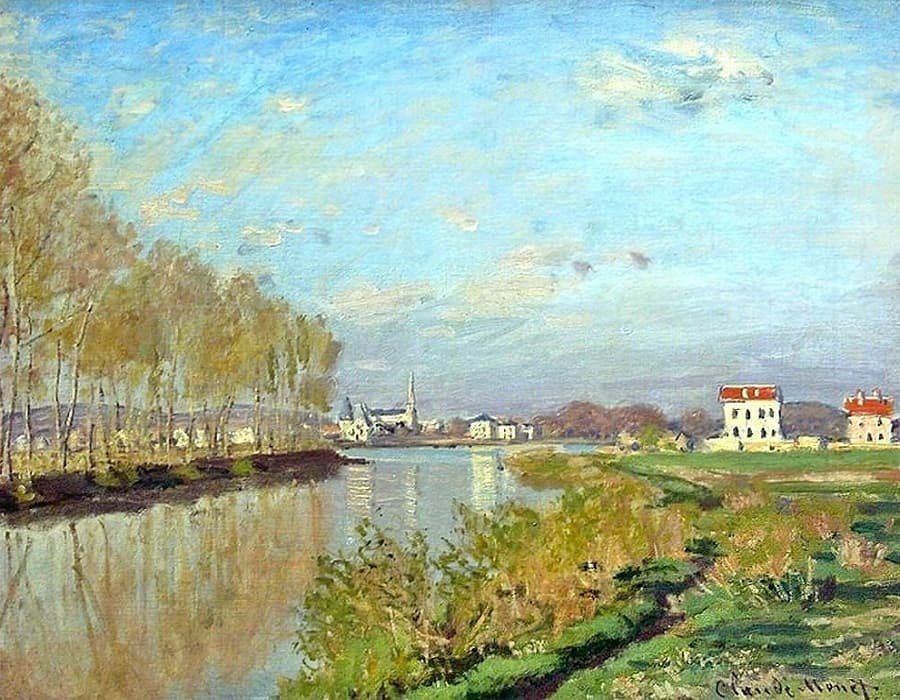
“The Seine at Argenteuil” (1873) is a beautiful, peaceful landscape painting from the time Monet spent living in the suburb of Argenteuil, just a short train ride outside of Paris. During this period, the River Seine was a bustling hub where city dwellers went on weekends to relax, row boats, and enjoy nature.
Water was his absolute favorite thing to paint because it acts like a mirror for light. Now on display at the Musée d’Orsay in Paris, this artwork shows the golden-brown autumn trees on the left and the white houses on the right melting into shimmering, wavy reflections on the river surface.
Monet beautifully balances the wild, soft look of the changing trees with the clean, structured shapes of the local houses and the distant church spire standing against the sky. Instead of using the heavy, dark colors common in older classical art, he used a bright palette of light blues, soft creams, and deep greens to make the entire riverbank feel fresh, open, and alive.
14. “Bain À La Grenouillère”

“Bain à la Grenouillère” (Bathing at La Grenouillère), painted in 1869, is a historic milestone in art. Now proudly displayed at The Metropolitan Museum of Art in New York City, this is the exact painting where Claude Monet, alongside his close friend Pierre-Auguste Renoir, accidentally invented the visual style of Impressionism. The scene shows a popular, trendy floating resort on the Seine River where fashionable Parisians gathered to swim, drink, and socialize.
In the summer of 1869, Monet and Renoir were incredibly poor, struggling artists living near each other. They set up their easels side-by-side at this resort, painting the exact same scene at the exact same time. If you compare their works today, Monet focused more on the ripples of light on the water and the open landscape, while Renoir focused more on the clothing and details of the people.
The focal point of the painting is a tiny, circular wooden platform built around a single tree, nicknamed “The Camembert” because it looked like a round wheel of French cheese. Tiny walkways connected this little island to the floating cafe on the right, making it the perfect centerpiece for Monet to capture the lively, sunlit energy of the crowd.
15. “San Giorgio Maggiore At Dusk”
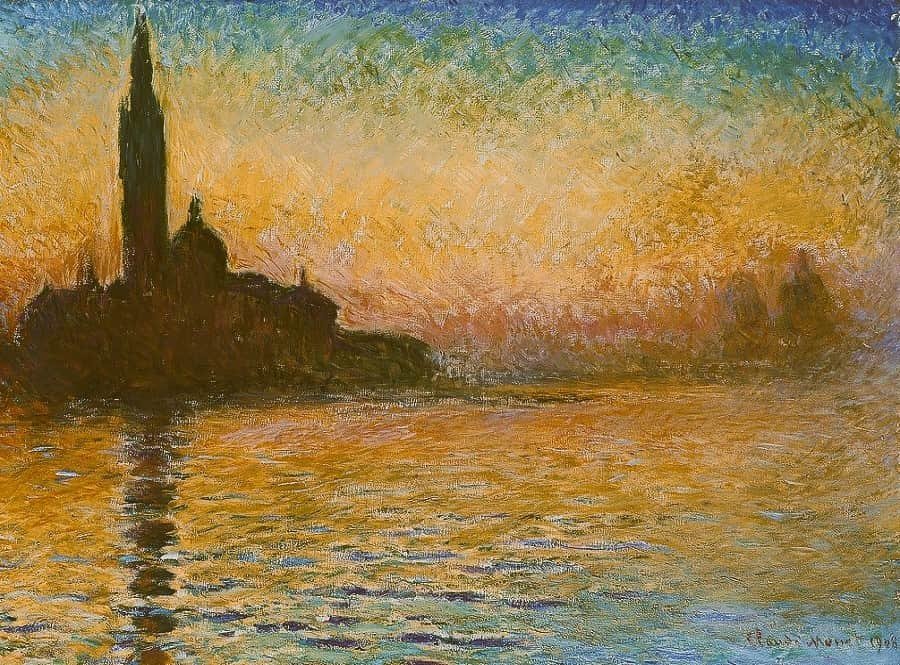
“San Giorgio Maggiore at Dusk” (1908) is one of Claude Monet’s most breathtakingly vibrant paintings. Created during his only trip to Venice, Italy, it captures a famous island monastery melting into a fiery sunset. Now a prized centerpiece at the National Museum Cardiff in Wales, the artwork looks less like a regular landscape and more like an explosion of pure light and emotion.
Monet captures the sky right at the moment the sun slips below the horizon. The clouds glow with brilliant yellows, hot oranges, and deep, blood reds. The actual island church and its tall campanile (bell tower) appear as a dark, purple-blue shape. Because he left out all fine architectural details like windows or doors, the entire building is reduced to a beautiful shadow shape floating between the sky and the sea.
When most people look at the canvas, their eyes go straight to the tall bell tower standing proudly in the center. However, if you look closely at the far right side, you can spot faint, ghostly shapes of passing gondolas, leaving the viewer with a beautiful, mysterious whisper of Venetian life.
All of these works of art are among the most famous Monet paintings in the history of Impressionism. Known for its fascination with the transient moments of life and the play of light and air, as well as the personal point of view of the artist. Monet managed to create his own style and make a great contribution to the art world thanks to his techniques and artistic vision.