Last Updated on 29th December 2025 by admin
Looking at the pictures of Socotra Island, many people think that they are viewing scenes of a science fiction film or a world created by digital technology. This remote island has an almost unreal look due to giant umbrella-shaped trees, bottle-shaped trunks that are growing out of rocky ground, and landscapes which appear to be untouched by time. It is no surprise that Socotra Island is often described as “the most alien-looking place on Earth.”
Socotra, situated in the Arabian Sea, has been millions of years old, and it has developed in complete isolation, not affected by busy continents and modernization. This isolation has given the nature to take its course and produce plants and animals that are not seen in the rest of the world. Visitors of Socotra, scientists, and nature lovers all share a similar opinion that Socotra is not like the rest of Earth.
In this article, we explore why Socotra Island looks like an alien planet, examining its geography and features of biodiversity, weird landscapes, climate, and cultural isolation. It is a deep dive that will make you realize why this island is one of the most incredible places on our planet.
Where is Socotra Island Located?

The Socotra Island is part of Yemen and is located in the Arabian Sea and close to the entrance of the Gulf of Aden, , which is one of the world’s largest gulfs. Geographically, it is nearer to Horn of Africa than the mainland of Yemen. This strange place significantly contributed to the development of the natural history of the island.
Socotra is separated by hundreds of kilometers of the ocean, and it has been isolated about 20 million years. There was no outside influence, which made plants and animals evolve differently during this long period. That is one of the main reasons the island’s ecosystems are so different from any other part of the Earth.
The Socotra archipelago is a group of four islands and a few rocky islets with this island of Socotra being the largest. Human population is still low despite its size, and big parts of the island are still completely untouched by modern infrastructure.
A Landscape That Feels Unfamiliar
The unusual and unfamiliar terrain of Socotra Island is one of the first things that the visitors observe. Socotra is not tropical and lush in the conventional sense as most islands are. Instead, the landscape appears raw, ancient, and strangely sculpted by time and natural forces. The land appears to be untouched by contemporary civilization and it was formed by the wind, erosion and geological forces over millions of years. This makes the atmosphere look like it belongs to a far-off planet rather than a spot on earth and instantly capturing the attention of anyone who sets foot on the island.
Rocky Plateaus and Limestone Cliffs
The Socotra Island is mainly covered with vast plateaus of limestone, sharp rocks, and steep rocky cliffs. These surfaces are usually dry, cracked and lifeless at the surface and their look renders the island harsh and desolate. But as one takes a closer look, one will realize a phenomenal strength of life. Endemic and rare plant species learn to survive in small cracks on the rocks and shallow soils and adjust to the high temperatures, great winds and low rainfalls. Erosion has over the years cut the limestone into greatly sharp ridges and dramatic effects that provide the landscape with the sculpted and often artificial appearance that is absolutely alien to the majority of tourists.
Caves and Sinkholes

There are also hundreds of sinkholes and limestone caves in Socotra, some of which have not been explored yet and most of which have not been documented. Others of these caves extend several kilometers through the ground and have amazing natural formations like tall stalactites, delicate stalagmites and huge chambers that are developed by thousands of years. Freshwater pools are present in some of the caves and this provides a source of water in an otherwise dry habitat. These systems underground contribute an additional layer to the geography of Socotra and contribute to its reputation of a mystery and otherworldliness because they remind the people visiting the island that a large portion of the natural history of the island lies beneath the surface.
White Sand Dunes and Turquoise Seas
Unbelievably contrasted with its rocky and rugged interior, the Socotra Island is also lined with white sand dunes and stunning coastline. There are also areas where the towering sand dunes are built right out of the shoreline and come into contact with crystal-clear turquoise waters of the Arabian Sea. Such a meeting of desert-like scenery with bright ocean generates surreal landscapes that are unreal to the eye. The contrast between vacant sand, deep water of blue color, and rocky hills makes it appear that the different worlds collide at the same location to increase the alien look of the island.
Plants Found Nowhere Else on Earth
The strongest reason Socotra Island looks like an alien planet is its truly extraordinary plant life. Millions of years of geographic isolation have resulted in the island developing one of the greatest measures of plant endemism in the world. Socotra has more than one-third of all plant species endemic, i.e. those found nowhere else on Earth. rare botanical uniqueness makes the island a living museum of evolution, in which the plants have pursued their own isolated course, untouched by outside influences. Most of these species look so unusual that they seem to belong to a science-fiction world rather than our earth.
Dragon Blood Tree – The Icon of Socotra
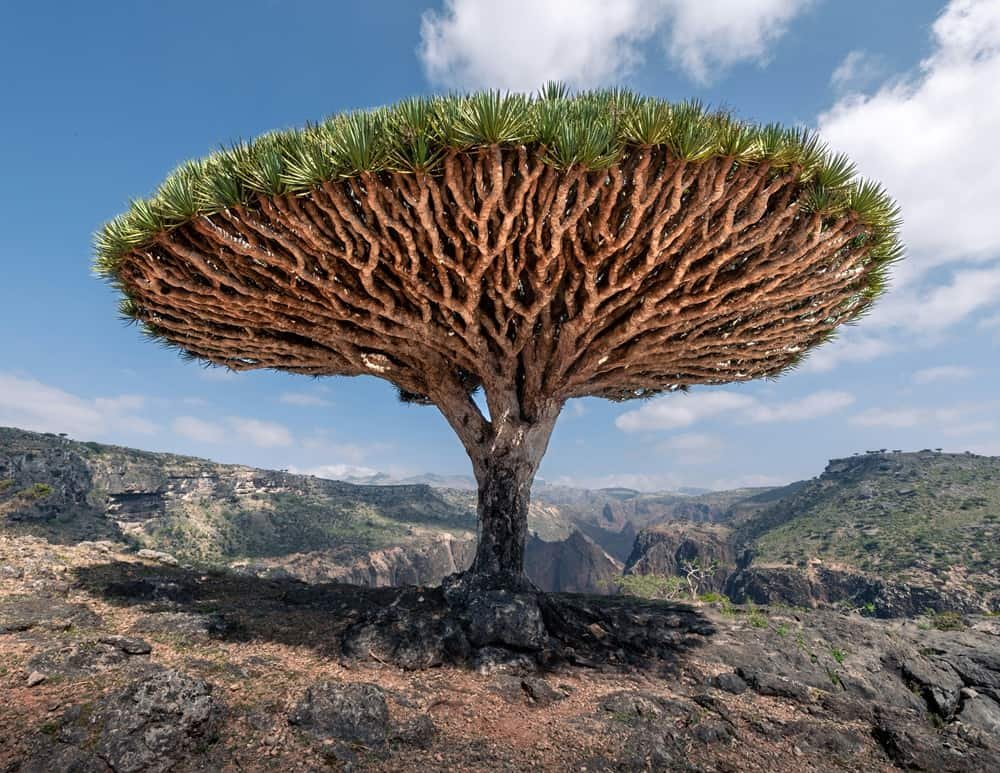
The most famous and instantly recognizable plant on Socotra Island is the Dragon Blood Tree. This tree with the thick trunk and unique umbrella canopy cover, this tree has been depicted as the ultimate symbol of the island’s alien-like appearance. A forest of Dragon Blood Trees can be viewed at a distance as a bunch of giant mushrooms or giant umbrellas that are frozen in time to leave behind an unforgettable visual experience.
Cutting the bark of the Dragon Blood Tree produces a resin of deep red, called dragon blood. Since ancient times, this resin has been appreciated and has been used in ancient medicine, dyes, varnishes, incense, and ancient rituals throughout the Middle East and other areas. The tree has traditionally been traded along the ancient sea routes, which also provided cultural and economic significance to it. The Dragon Blood Tree today is a worldwide symbol of the uniqueness and delicate biodiversity of Socotra.
Bottle Trees and Strange Shapes
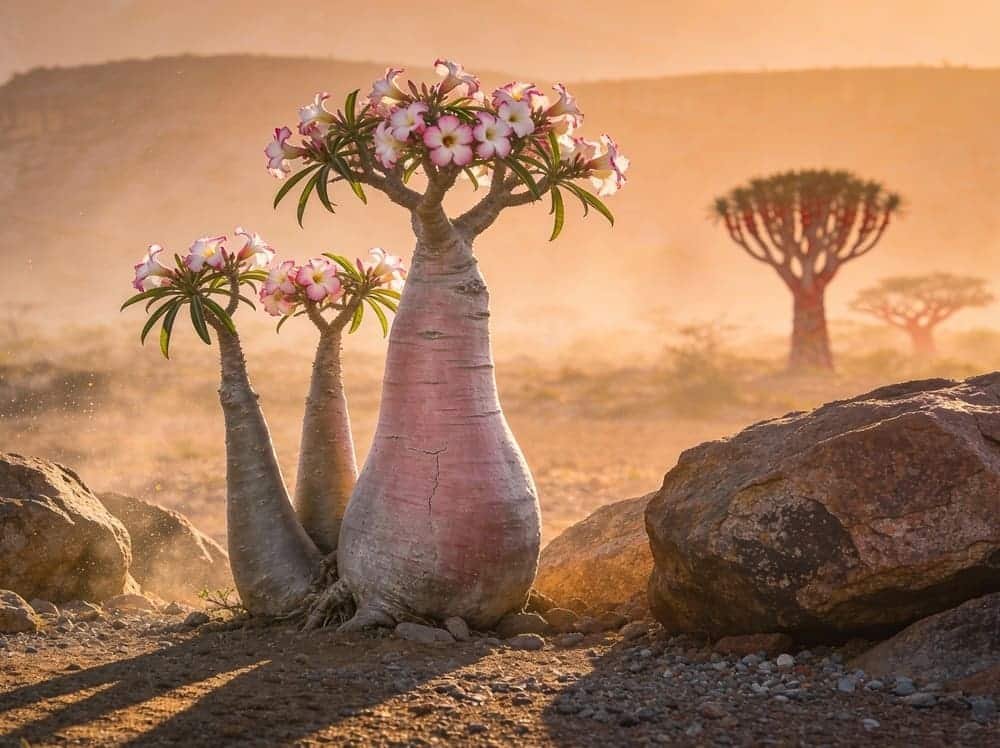
The other interesting characteristic of the vegetation of Socotra is the existence of many bottle-shaped trees with swollen trunks and abnormal growth patterns. To survive in such a place where rain falls are very minimal, these trees have developed a mechanism of storing water in their thick trunks. Their weird, overblown shapes break the common concept of what a tree is expected to be, and most of the time the visitors are surprised.
These strange forms are not decorative, but functional, and are due to the influence of natural selection in millions of years. The trees in most occasions have irregular growth of branches or even wavy edges making them look almost sculptural. This functionality and aesthetics make this island an even more exotic-looking landscape which was attributed to the fact that Socotra was one of the most alien-looking landscapes on Earth.
Plants That Defy Harsh Conditions
Socotra despite the extreme heat, strong winds, and limited water supply, is known to have a large number of plant life surviving incredible odds. There are species that are dormant most of the time, which only spring into action after a monsoon shower is received after a long period in dormancy. In these short periods the island is changed, and with sudden bursts of color covering the otherwise dry terrain.
some plants have adapted to it by growing low to the ground or clinging closely to rocks, and limiting their exposure to high winds. Other have waxy thick leaves which reduce the amount of water loss. This spectacular versatility is almost unnatural compared to the plants elsewhere, which further supports the notion that Socotra has its own system of rules of evolution. These plants of great strength serve as a strong reminder of how nature can also change and endure even in the most harsh conditions.
Rare and Isolated Wildlife
Although the Socotra Island is widely recognized as the place of incredible plant life, the wildlife of this island also contributes greatly to its weird and alien nature. Because of millions of years of isolation, the animal species of Socotra have diverged as a result of their evolution compared to the other continents. Even though there are no large mammals or dense animal populations on the island, the species that are on the island are highly specialized and uniquely adapted to the harsh environments on the island. This weird mixture of life forms adds to an ecosystem that is somehow unlike those elsewhere in the world.
Endemic Reptiles and Birds
There are dozens of species of reptiles in Socotra that cannot be found anywhere on the planet, including diverse geckos, skinks, and lizards that have adapted to the rocky terrain of the island and extreme temperatures. Most of these reptiles have adapted flattened bodies, toe pads, and colonial color which enable them to move freely over cliffs, caves and sun-baked stone surfaces. They can live on a minimum amount of water and even under hot weather, which shows just how extreme the ecological conditions are on the island.
Birds also have a significant habitat on the island, resident and migratory. There are a number of bird species endemic to Socotra, and many other species make the island an important stopover on long-range migrations between Africa and Asia. Socotra is also an important bird conservation site in the area due to coastal cliffs, wetlands and inland plateaus that offer nesting and feeding grounds.
Limited Mammals
Unlike many islands around the world, Socotra has very few native land mammals. This absence has had a profound impact on the island’s ecological balance. Without dominant mammals to control food chains, reptiles and birds have taken on ecological roles typically filled by mammals elsewhere. As a result, these species have become more prominent and influential within the ecosystem.
Socotra has very few native land mammals, unlike many other islands in the world. Such a lack has greatly affected the ecological balance of the island. In the absence of the dominant mammals to regulate food chains, reptiles and birds have assumed the ecological roles that are normally occupied by the mammals in other areas. Consequently, such species have gained prominence and power in the ecosystem.
This unusual structure creates a rare and delicate balance, with even little species having essential roles towards supporting ecological stability. This also prevented any large predators so some reptiles and birds have flourished devoid of competition which further supports the Socotra image as a place where nature has its own rules. Together, these factors make the island’s wildlife as alien and fascinating as its landscapes and plant life.
Climate That Shapes an Alien World
The climate of the island is an important factor that contributes to the unusual and alien-like looks of Socotra. Socotra is not like many tropical islands, which have recurrent rainfall and predictable weather patterns because it is affected by extreme seasonal forces that dictate the survival and growth of life. Strong monsoon winds, extended dry seasons, and irregular precipitation have led to some plants and animals adapting in a strange manner. This extreme climate has taken millions of years to filter species, eliminating the most delicate ones as evidenced by the unfamiliar and highly specialized ecosystems.
Monsoon Winds
For several months each year, Socotra Island is exposed to intense monsoon winds that sweep across the Arabian Sea. These winds are so strong that traditional fishing boats and modern vessels alike are often unable to approach the island’s coastline during this period. The sea becomes rough, isolating Socotra from the outside world and reinforcing its long-standing geographical isolation.
The vegetation is directly affected by these strong winds. The trees and shrubs do not grow tall, they are spread and form a low and wide canopy which is less resistant to wind. Branches tend to be growing at odd angles, and leaves become smaller and harder to avoid being damaged. This form of growth that is in the shape of a wind is one of the factors that have made most of the plants of Socotra look distorted or alien.
Low Rainfall, High Survival
Rainfall on Socotra Island is both limited and unpredictable, with most of the year being under a long dry spell. Plants have adapted to receive moisture on the mist, humidity, and some rain on monsoon showers instead of depending on regular rainstorms. There are several species that can store the water in thick trunks, swollen stems or fleshy leaves as a result they can survive several months without rain.
Root systems too have changed and spread far and wide over rocky surfaces to absorb all drops of moisture available. There are plants that are always in the dormant state and suddenly sprout into a high developmental growth and flowering upon the arrival of rain. Such survival adaptations have given rise to vegetation that is unfamiliar, and near unnatural compared to the vegetation found in more stable climates. The austerity climate and the impressive adaptations combined make Socotra even more alien-like and earn it the title of one of the most alien-looking environments on Earth.
Millions of Years of Isolation
The alien-like appearance of Socotra Island is the direct consequence of the millions of years of geographic and biological isolation. It was approximately 20 million years ago that the island split off of the old supercontinent Gondwana and has been mostly isolated by the neighboring landmasses ever since. Socotra developed in almost complete isolation as opposed to areas where recurring interactions with continents occurred. This has enabled plants and animals to grow freely with no external species or predator.
Evolution over time favoured strange shapes, growth patterns, and the survival of other environments that would have not survived otherwise. A number of species adapted exclusively to the conditions of Socotra, the severe climate, the great winds, and the absence of water, which makes the life forms look alien and weird. The topography of the island was also able to develop gradually and in an uninterrupted manner, by the forces of nature like the erosion and climate only. Collectively, this profound isolation helped to preserve ancient ecosystems and make Socotra so unique and alien in its nature.
Human Life on a Different Timeline
The life of a human on the island of Socotra is as strange as its environment and fauna. Human presence on the island has been a limited, balanced, and sustainable phenomenon, which has been determined by isolation and severe environmental conditions over centuries. The communities of Socotra learned to live with the island, as opposed to remaking it like many other regions of the world where development changed the natural environment at high rates. This slow and careful interaction with nature has allowed the island to retain its raw and ancient character, reinforcing the feeling that life here follows a different timeline.
Traditional Lifestyle
Fishing, herding, and minor farming remain the sources of livelihood of many Socotra residents. Animals like goats and sheep are reared in balance with the natural environment and fishing is a mandatory source of food and income in the coastal region. Conventional houses are constructed with local materials and minimalistic designs which naturally merge into rocky and sandy geography. These structures do not require vigorous construction and rearrangement of the land, which keeps the appearance of the island natural.
Minimal Urban Development
Socotra does not have any big cities, highways, or industrial areas. There is a limited number of roads, modest infrastructure, and modern buildings are hard to find. This absence of the massive urban growth contributes to the preservation of the untouched beauty and silence of the island. Thus, Socotra seems to be stuck in time- a place where people live in harmony with nature and not on it.
Why Scientists Call it the “Galápagos of the Indian Ocean”
Scientists often refer to Socotra Island as the “Galápagos of the Indian Ocean” because of its exceptional level of endemism and evolutionary uniqueness. Similar to the Galapagos Islands, Socotra has been isolated over millions of years where plants and animals evolved independently. But Socotra is still older geologically and possesses a larger percentage of endemic plant species than the Galapagos.
The Socotra is researched to learn how life can evolve under severe life conditions of high winds, low rainfall and poor soils. The island is used as a natural evolutionary, climate adaptation, and biodiversity conservation laboratory. Its isolated ecosystems contain priceless information on the way of life in the deep time being carved by isolation and it is one of the most significant scientific location in the world.
UNESCO World Heritage Recognition
Due to its excellent natural value, Socotra Island was listed as a UNESCO World Heritage Site in 2008. This acknowledgment makes the island significant to the world as one of the most diversified and ecologically distinguished locations on our planet. UNESCO recognized Socotra due to its amazing flora, great endemics of species, and well-conserved ecosystem that has not been significantly affected by recent development.
There is also responsibility associated with World Heritage status. It highlights the importance of preventing the threats to Socotra which may include climate change, overgrazing, and uncontrolled tourism. Conservation activities tend to stabilize human needs and environmental protection in such a way that the delicate ecosystems on this island may survive to live to the next generation. UNESCO recognition has also served to bring world awareness into the significance of Socotra besides promoting sustainable management of the natural resources available.
Why Socotra Truly Feels Like an Alien Planet
Socotra truly feels like an alien planet because it combines unfamiliar landscapes, strange plant forms, rare wildlife, extreme climate, and deep isolation in one place. Each part of the island, the umbrella-like trees and bottle trunks, the wind-shaped landmasses and the silent plateaus, do not look like what the majority of the population would imagine Earth to be. There are no huge cities, no massive infrastructure, and no mass tourism, which only adds to this sense of entering a different world.
Instead of being influenced by human activity, Socotra has been influenced by time, nature, and isolation. It is a form of the Earth in which evolution took a different route and formed beings that seem primitive and alien. Socotra can serve as a reminder that in this fast-paced world, there are still places on earth that are yet to be explored, mysterious, and apparently alien.
Conclusion
Socotra Island seems to be an alien planet, not in the sense of being imaginary, but because it represents Earth at its most creative and untouched. Many millions of years of isolation, high temperatures and self-regulated evolution process made the landscape unfamiliar, mysterious, and breathtaking.
In a world increasingly shaped by human activity, Socotra stands as a reminder of what nature can create when left alone. For students, travelers, and geography enthusiasts, It is one of the most interesting places on the Earth to students, travelers, and lovers of geography – it is a living example of how strange our own planet sometimes can be.