
Last Updated on 23rd March 2026 by admin
There are some places that are not special on a map, but quietly control a big portion of how the world works. The Strait of Hormuz is one of those places. It is a narrow strip of water, not very wide, not the most of people usually talk in their everyday life, but still, it plays a major role in global trade and energy.
Each and every day, massive ships carrying oil pass through this small route, connecting the Persian Gulf to the open sea. Because of this, many countries depend on this small but very important route. It might seem small, however, Strait of Hormuz is one of the most important waterways in the world.
Where Is the Strait of Hormuz?
The Strait of Hormuz is located in the Middle East, situated between Iran and Oman. It serves as a small passageway that connects the Persian Gulf to the Gulf of Oman, and from there ships can easily move into the larger Arabian Sea and beyond.
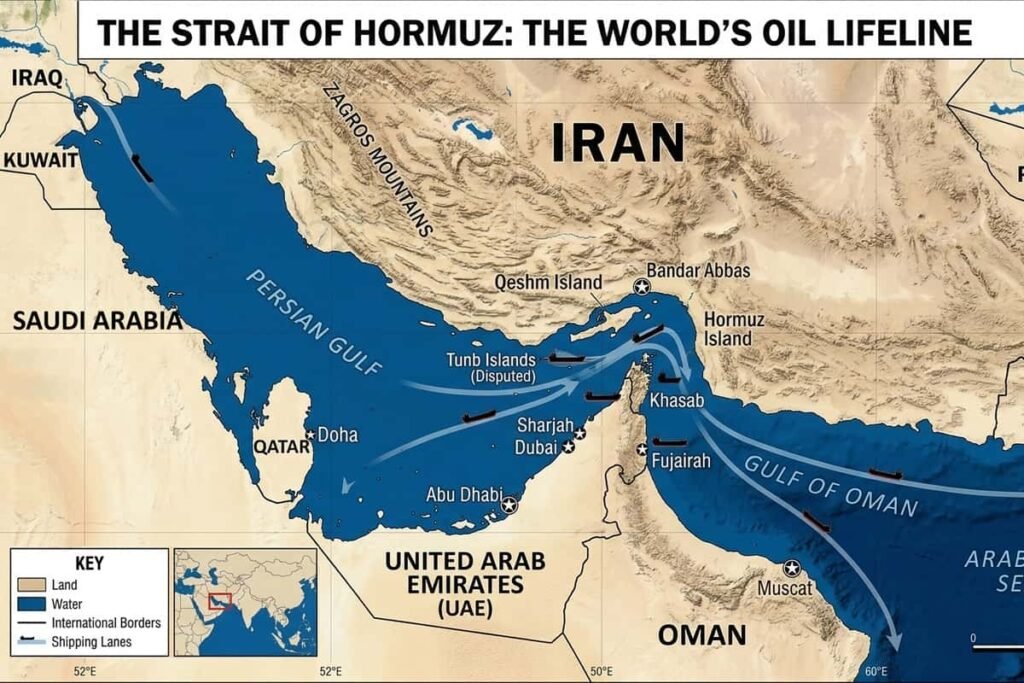
If you look at it on a map, it may just seem like a small strip of water. But in reality, it is in a very strategic location. Nearly all that carry oil and goods from countries in the Persian Gulf must pass through this route to reach other parts of the world. Alternative paths are very few, and so this strait is even more important.
Because of this, the Strait of Hormuz is commonly referred to as a “chokepoint”, or in other words, a location where traffic forced through a narrow space. And significant portion of the world’s energy supply is depends on one narrow passage, even a small disruption here can have a global effect.
Why Is It So Important?
The importance of the Strait of Hormuz mostly comes down to one thing, which is energy. While the Strait of Hormuz is known for its global importance, the Arabian region is also home to unique places like Socotra Island, famous for its alien-like landscape. This narrow waterway is one of the main routes through which oil moves from the Middle East to other parts of the world.
A large amount of oil exported by countries such as Saudi Arabia, Iraq, and United Arab Emirates passes through this single route. Because of that, there are many countries in the world that rely on it without even thinking about it.
What is even more serious is that there are not many easy alternatives. If this route gets disturbed or blocked, oil supply can slow down quickly. And when that happens, fuel prices increase, transport becomes costly and it can influence the daily life of most countries.
So despite being a very small strip of water, its importance is massive. It silently supports global trade, energy supply, and the smooth functioning of economies around the world.
The World’s Oil Lifeline
The Strait of Hormuz is also referred to as the oil lifeline of the world, and honestly, that name fits perfectly. Every day, huge oil tankers pass through this narrow route and carrying energy from the Middle East to different parts of the world.
It is not only a few countries that depend on it. These supply sources are essential to major economies such as India, China, and Japan. Other countries like South Korea, Singapore, Thailand, and Pakistan are also dependent on the oil that passes through this route. Even some European countries feel the impact, because global energy markets are all connected.
In most of these countries, this oil is a lifeline to ensure that industries running, transportation moving, and daily life normal. Things can get costly very quickly without a steady flow and fuel prices rise, shipping costs increase, and that eventually affects the price of everyday goods.
What’s interesting is that most people don’t really think about this connection. The Strait of Hormuz seems a long distance to many of us, but its impact is very near. Any form of interference here can cause an impact across the globe.
So in a way, this narrow waterway is performing a huge task in the background. It might appear small in a map, but it has an enormous impact on ensuring that the global economy continues to go.
A Narrow but Powerful Passage
The width of the Strait of Hormuz is actually one of the most surprising facts about it. The strait is at its narrowest length only approximately 33 kilometers. And in reality, the ships do not take the entire width at all, they have special shipping lanes, and thus the space available is even less.
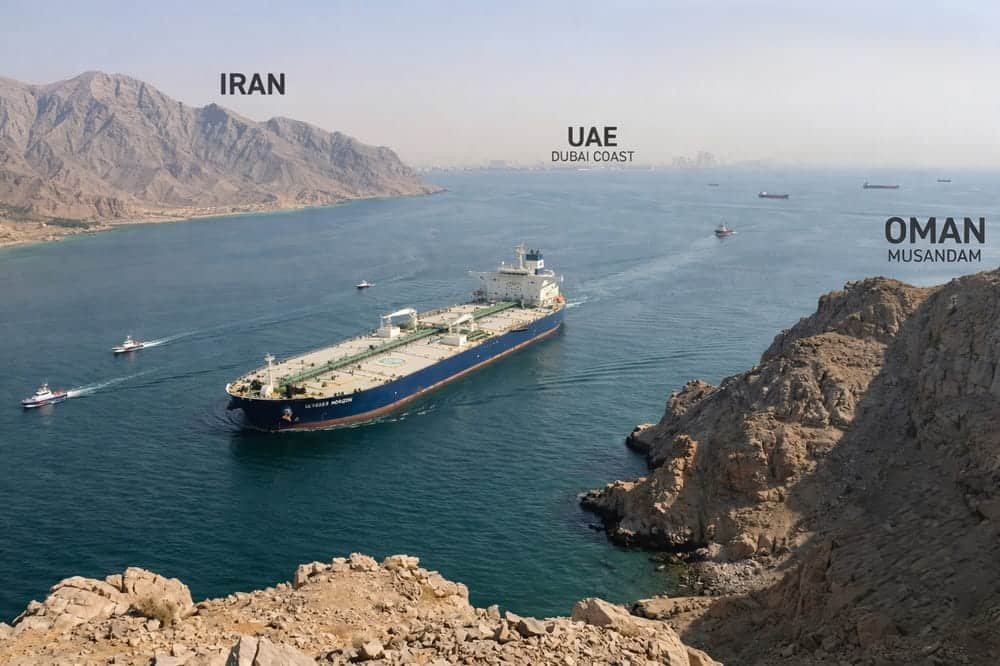
Suppose the following: the largest oil tankers in the world together with cargo ships and even military vessels pass through this narrow area daily. It is something like traffic on a busy highway, except it is over water, and the stakes are even greater.
The passage is very narrow, so a simple problem can easily develop into a huge problem. A delay, an accident, or any form of tension in the region can slow or interrupt ship flow. And because a huge proportion of the oil that goes through the world is through this area, even a small effect can be spread further.
That’s what makes it powerful. It is not wide or massive, but its position and role give it huge importance. A small stretch of water, but with the ability to influence global trade and energy in a big way.
Geopolitical Importance
The Strait of Hormuz does not only hold significance as far as trade and oil are concerned, it also possesses immense political and strategic importance. The fact that a large portion of the global energy flows through this small path causes many nations to pay a close monitoring over what occurs at this small location.
The strait is a stretch that is separating Iran and Oman, and this is an area where tensions have existed over the years. The Strait of Hormuz is always in the spotlights whenever there is any conflict or disagreement.
Strong nations such as the United States frequently place a naval force in the region to make sure that ships can move safely. This shows how seriously the world takes this route. It is not only a matter of a region but the stability of the global trade.
Even minor incidents here can raise concern in international markets. The news on this front can have a fast impact on oil prices and world confidence. That is why the Strait of Hormuz is a topic of continuous conversation as far as geopolitics are concerned.
In simple words, it’s not just a waterway, it’s a place where global interests, security, and politics all come together.
What Happens If It Closes?
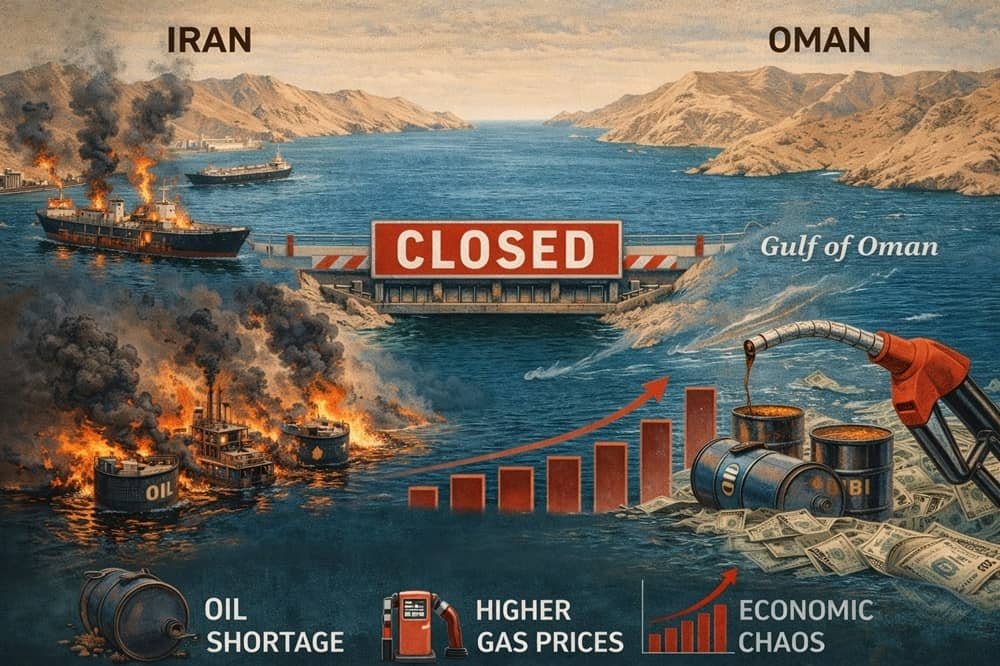
In the case that the Strait of Hormuz is ever blocked or closed, even temporarily, the impact would be felt across the world almost immediately.
The first scenario that would occur is the immediate decline in oil supply. A significant part of the world oil flows by this route and any disturbance would cause panic in the energy market. Due to this, oil prices would be increased at an extremely high rate and this would be reflected in the prices of fuel in most nations.
This would not simply stop at petrol or diesel. Increased fuel prices result in high cost of transportation and consequently the cost of goods, food and other day-to-day necessities. People, even people far away on the other side of the world, would begin to feel the impact.
The major problems would be experienced by countries which are major consumers of imported oil such as India, China and Japan. Governments may have to seek other options or rely on emergency reserves, but that is not necessarily a fast and simple solution.
In short, closing the Strait of Hormuz would not just be a regional issue but also an international problem. This is why it is so important to the whole world to maintain this route open and stable.
Even a small break can cause panic in the energy markets. That is why it is regarded as one of the most important “chokepoints” in the world.
Quick Facts
- Here are some simple and important facts about the Strait of Hormuz:
- 📍 Location: Between Iran and Oman
- 🌊 Connects: Persian Gulf to the Gulf of Oman
- 📏 Width: Around 33 km at its narrowest point
- 🛢️ Global Role: One of the world’s most important oil transit routes
- 🚢 Traffic: Thousands of ships pass through every year
- ⚠️ Type: Known as a major global “chokepoint”
- 🌍 Impact: Plays a key role in global trade and energy supply
These facts may look simple, but they show why this small waterway has such a big importance in the world.
The Strait of Hormuz may look like just another narrow waterway, but its importance is on a completely different level. It quietly supports global trade, keeps energy flowing, and connects major economies. It is one of those places, where most of the people do not think about until it does. And when it does, the entire world begins to starts paying attention.