
Last Updated on 26th November 2025 by admin
Prague Astronomical Clock or Orloj located in the heart of Prague’s Old Town Square, stands as one of the most captivating and mysterious monuments in Europe. With its complex mechanism, gothic beauty and centuries of myths and legends, this medieval clock has fascinated millions of visitors from around the world. It is more than a clock that tells time, the Orloj is a living symbol of the soul of the city of Prague – an artistic masterpiece that continues to tick with pride more than six centuries since it was created.
A Glimpse into Time: The Story Begins
The Prague Astronomical Clock was set up first in 1410, which makes it the third oldest astronomical clock in the world and the oldest clock operating in the world. Among the historic clock towers of Europe, it stands as one of the most remarkable achievements of medieval engineering. Its history started with Mikuláš of Kadaň as a master clockmaker and Jan Šindel as a professor of mathematics and astronomy at Charles University.
Together they created a clock which would not only show time but also show the movements of the celestial bodies – a perfect fusion of science, craftsmanship and art. Later in the 15th century Master Hanuš (also called Jan Růže) contributed to the improvement of its mechanical and artistic aspects, for which his name forever became associated with the legend of the clock.
For more than 600 years, the Orloj has managed to survive wars, fires, and changes of political regimes. It remains today not just as an mechanical wonder, but symbol of the resilience of the Prague heritage as well as the human fascination in the magic of Time.
The Architecture and Design: A Work of Art in Motion
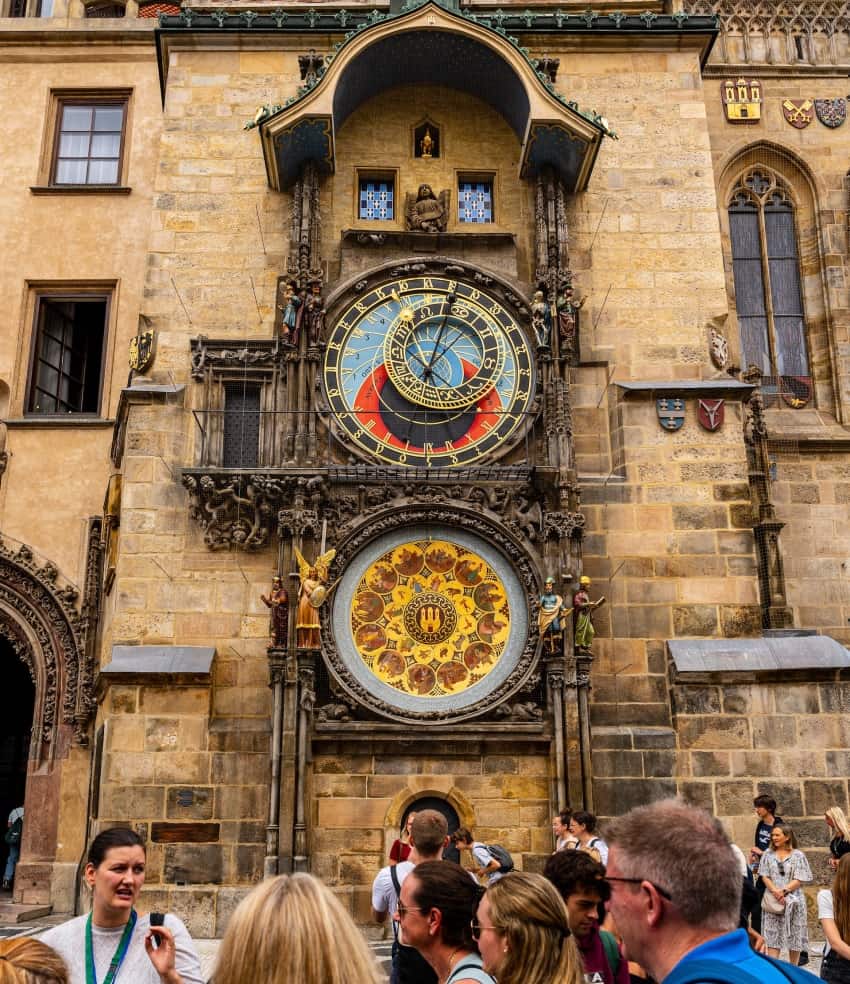
The Orloj mounted on the southern wall of the Old Town Hall, a building from the year 1338 in Prague. This beautiful clock not only the oldest clock, but it is also incredibly complex. The whole mechanism and the facade are three distinct parts that stand for different aspects of time and philosophy.
1. The Astronomical Dial
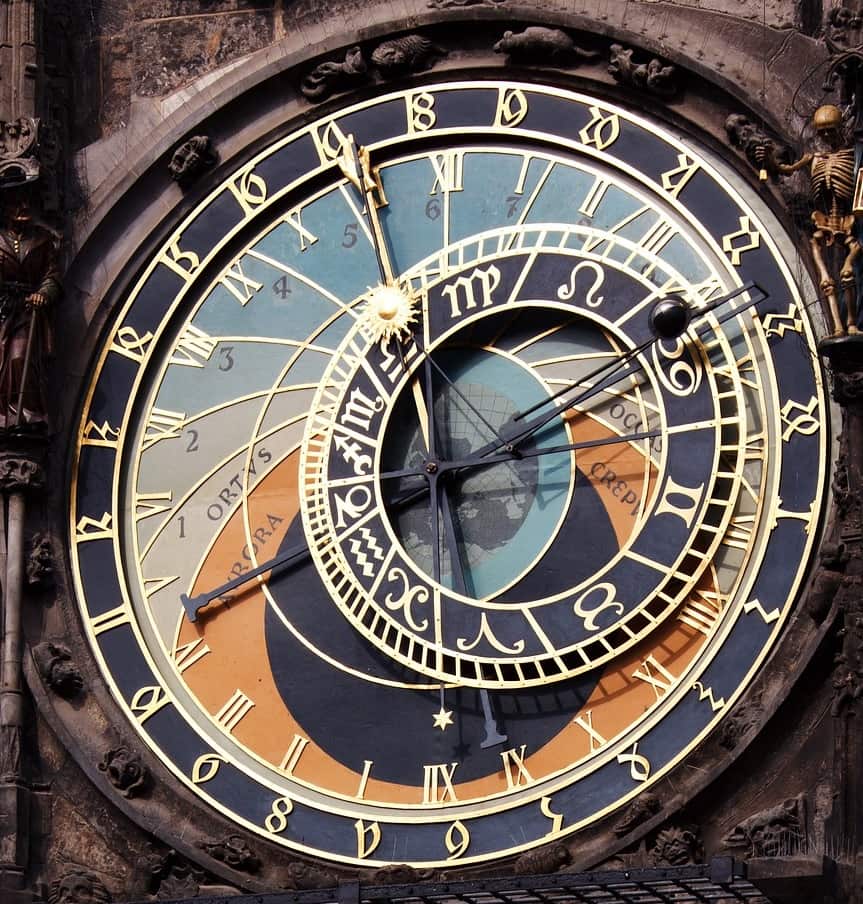
At the top of the clock is the astronomical dial – Orloj’s heart. It depicts the position of the Sun and the Moon in the sky, phases of the Moon and various astronomical information such as zodiac signs and Old Czech time.
The background is the earth and the sky: blue for the heavens above the horizon, brown for the earth and black for the night sky. The golden Sun is on a circular path, demonstrating the time of day of sunrise, sunset, and the passage of time.
Each component of this dial was carefully designed to combine elements of science and religion, as it depicts not only the hours, but the mankind’s relation with the cosmos as well.
2. The Calendar Dial
Astronomical face below was added in 1490 the calendar dial as the artist Josef Mánes. This multicoloured disc has the months of the year printed on it in the form of splendidly painted medallions depicting rural scenes – from harvesting to winemaking.
Along the outer ring are the names of saints, which refers to the calendar of religious feasts of medieval times. To this day, the calendar dial gives visitors an idea of how the past people viewed time as a rhythm of faith and nature.
3. The Walk of the Apostles
Every hour, on the hour between 9 AM and 11 PM, crowds congregate below the clock to watch its most magical spectacle – The Walk of the Apostles. As the bells start ringing, two small doors above the dial open, and twelve moving figures of the Apostles can be seen in them.
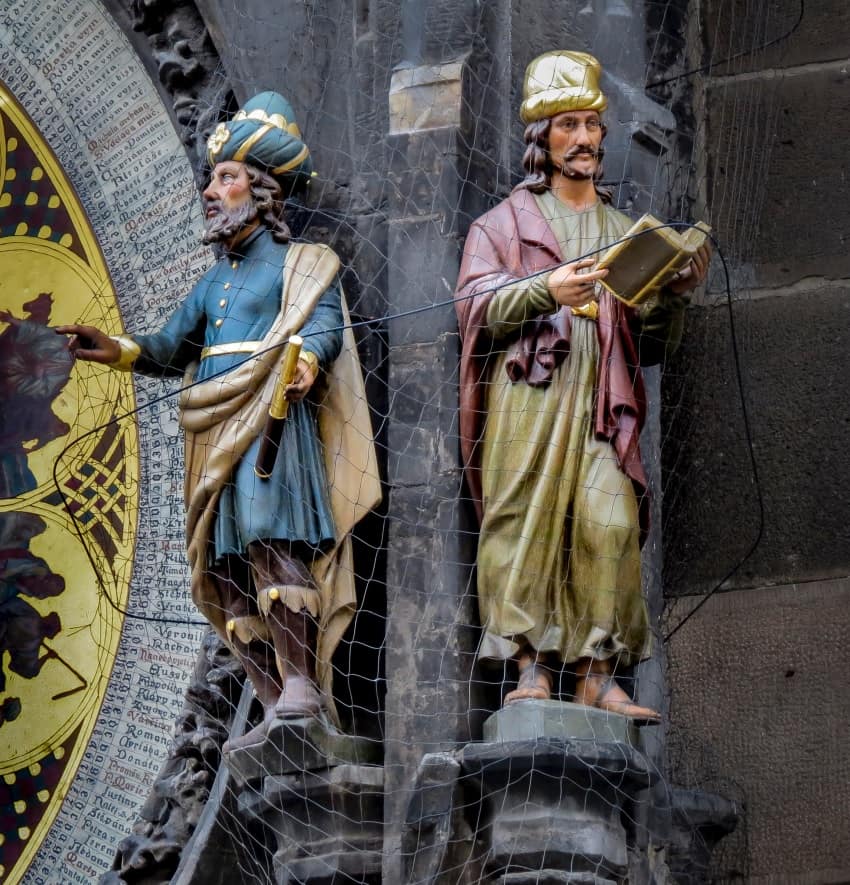
Each figure moves past the windows to bless the city before vanishing again. Other symbolic characters are brought to life around them: Death (a skeleton) sounding his bell, Vanity admiring himself in a mirror, Greed (a miser) shaking his purse, and a Turk shaking his head, representing the worldly pleasures.
Finally a golden rooster crows and the hour strikes – a sort of moment of wonder, since has delighted locals and travelers alike for centuries to come.
Legends and Myths: The Curse of the Clock
Like all medieval masterpieces, the Orloj is framed with legends. One of the most notable legends is the one about Master Hanuš, who supposedly was blinded by the Prague Councilors after he had built the clock so that it could never be as beautiful in somewhere else.
Legends have it that Master Hanuš took his revenge by going to the clock tower and throwing himself inside. He accomplished his goal of killing himself and stopping the clock, after which the clock remained stopped for many years. After some years, a craftsman managed to get it working again. Many thought that the city would be in misfortune when the clock stopped ticking.
Another legend believes that there is a guardian spirit hidden and looking after the clock. It’s said that when the Orloj stops, the spirit of Prague itself becomes restless – a myth which continues to fascinate people who live and work in Prague and those who come to see the magnificent clock. They are indicative of the deep emotional connection which the people of Prague held towards this amazing timepiece.
Surviving the Test of Time: Wars and Restorations
The journey of the Prague Astronomical Clock has not been an easy one. It has been damaged and rebuilt many times over throughout the centuries due to political unrest, fire, and wars.
During World War II, in May 1945, when the Old Town Hall was consumed by fire when the German armies set fire to the building during the Prague Uprising, the clock suffered a severe blow. The calendar dial and many of the wooden statues were burned to ashes. The Old Town square of Prague was quiet for a while.
After the war, a team of dedicated craftsmen and engineers worked hard to repair it. By 1948, the world clock was once again ticking for the city of Prague representing strength and re-birth.
Further restore have seen take place in 1962, 1979 and most recently in 2018, when the ctiy of Prague unveiled a carefully restored mechanism that remains true to that which it represents.
Understanding the Mechanics: A Medieval Marvel
The genius of the Orloj is in its complex mechanism which includes astronomy, mechanics and art all combined in one synchronised display.
At its core are three systems:
- The mechanical clock, which keeps standard time.
- The astronomical dial, which tracks celestial movements.
- The Apostles’ parade mechanism, which operates the figures.
Unlike modern digital clocks, every gear, pulley, and lever in the Orloj works through precise mechanical balance — driven by weights and controlled by centuries-old technology.
In a world of instant technology, the Orloj stands as a living reminder of an era when knowledge was sacred and craftsmanship was divine.
Symbolism and Meaning: More Than Just Time
Every detail of the Prague Astronomical Clock has a symbolic meaning. The four figures around the dial, Vanity, Greed, Death, and the Turk, are the sins and fears of man. Their hourly bobbing and weaving remind us of the constant nature of the human plight to make sense of the fleeting nature of life and the need for humility.
Above them the Apostles seem to bless the city which is a symbol for faith and hope. Below the calendar dial, the cycle of seasons is depicted and time is seen as a circle, not a linear process.
For the medieval people this clock was not just a way to tell time – it was a philosophical map of the universe, according to their understanding of God, nature and destiny.
A Living Landmark: Visiting the Orloj Today
Today, Prague Astronomical Clock is one of the most popular attractions in Prague and is visited by millions of tourists each year. You will find it on the southern facade of the Old Town Hall, facing the colorful square with a spotted with cafes, street performers and Gothic architecture.
Religious pilgrims gather in expectation each hour of the clock’s animation from dawn till dusk. As the figures move and the rooster crows, the phones come up to capture the moment – but the magic really is in the moment of watching that time studied with unprecedented values over the centuries to slip away, watching ticked before your eyes.
In addition to the timeless beauty of the Orloj is the Old Town Hall Tower, which can be climbed by visitors and offers a panoramic view of the red rooftops of Prague and the Vltava River.
Fun Facts About the Orloj
- The Prague Astronomical Clock was installed in 1410, making it more than 610 years old.
- It is the third-oldest astronomical clock in the world and the oldest still working.
- The zodiac ring rotates once per sidereal day (approximately 23 hours, 56 minutes).
- The golden hand on the clock represents the Old Czech Time – calculated from sunset
- Each Apostle holds a special object – St. Peter holds a key and St. Paul holds a sword.
- The crowing rooster was added during the 17th century and was used as a symbol of the triumph of light over darkness
- The Orloj survived both the Thirty Years’ War and World War II – and still operates using its original mechanism.
Why It Still Captures Hearts Today
There is something magical about the Orloj that words can hardly describe. Maybe it is a blend of medieval craftsmanship and an artistry of time. Or perhaps, it’s the feeling that this ancient clock has silently seen the rise and fall of empires, watched the laughter of weddings, and the whispers of revolutions – in the same square.
In a time where most people are checking their time with their smart phones, the Prague Astronomical Clock is a good reminder that time itself can be art. Its rhythmical ticking, however, is not only the passing of hours but the heartbeat of Prague – ancient and proud, with a lot of stories.

A Timeless Legacy
Over six centuries since it began to tick for the first time, the Orloj continues to be an unending masterpiece of human ingenuity. It has given birth to countless artists, scientists and dreamers who each in turn have recognized how something such as this that is so old can appear so alive.
The clock is a reminder for visitors– each sound provides a connection to the past, reminding visitors that history is not only found in books; it lives in the actions, objects, and rhythms of a place like this.
The Prague Astronomical Clock is not just a machine but rather a messenger from the Middle Ages who is trying to talk to you across centuries:
“Time is precious — make every moment count.”
If You Visit Prague…
No trip to the Czech capital is complete without standing in front of the Orloj – the Astronomical Clock – waiting for the hourly performance and feeling history alive again. Whether you have a fondness for medieval art, are interested in astronomy, or are just a visitor struck by beauty, the Prague Astronomical Clock is a must see – a true symbol of time, art and the everlasting spirit of Prague.